

A 240Z with the right stance is hard to look away from - low enough to look intentional. But not so slammed that it scrapes every parking lot exit. For owners who want that, the path is more involved than any single product can address. Ride height, wheel offset, fender clearance and camber all want to pull in different directions at once - dial in just one without accounting for the rest of them and the whole build tends to pay for it.
Coilover kits, spring sets, flares and camber plates - the options pile up fast, and one bad buy can cause two or three more. Wheels ordered before you've confirmed your offset can leave your tires either sitting way out past the fenders or tucked awkwardly underneath them. A suspension drop without an alignment plan will wear through a fresh set of tires in a single season - straight down to the cords. It's a painful one, and it didn't have to happen.
Ride height dictates your wheel fitment. Wheel fitment dictates your fender work. The fender work then determines how far you can push your camber before it starts to hurt drivability. Every step limits what the next one can be - it's what makes the whole process so rewarding when it all comes together. Get the sequence right, and the result is a build that gets seen for the right reasons!
Let's go through how to get your Datsun 240Z set up just the way that you want!
Table of Contents
Pick the Right Stance for Your 240Z
Stance is just how a car sits - the ride height, the wheel fitment and the way the tires fill the fenders. When all three are dialed in together, the car looks like it was built to be that way. When even one of them is off, something about the whole package feels wrong, and you might not be able to say what.
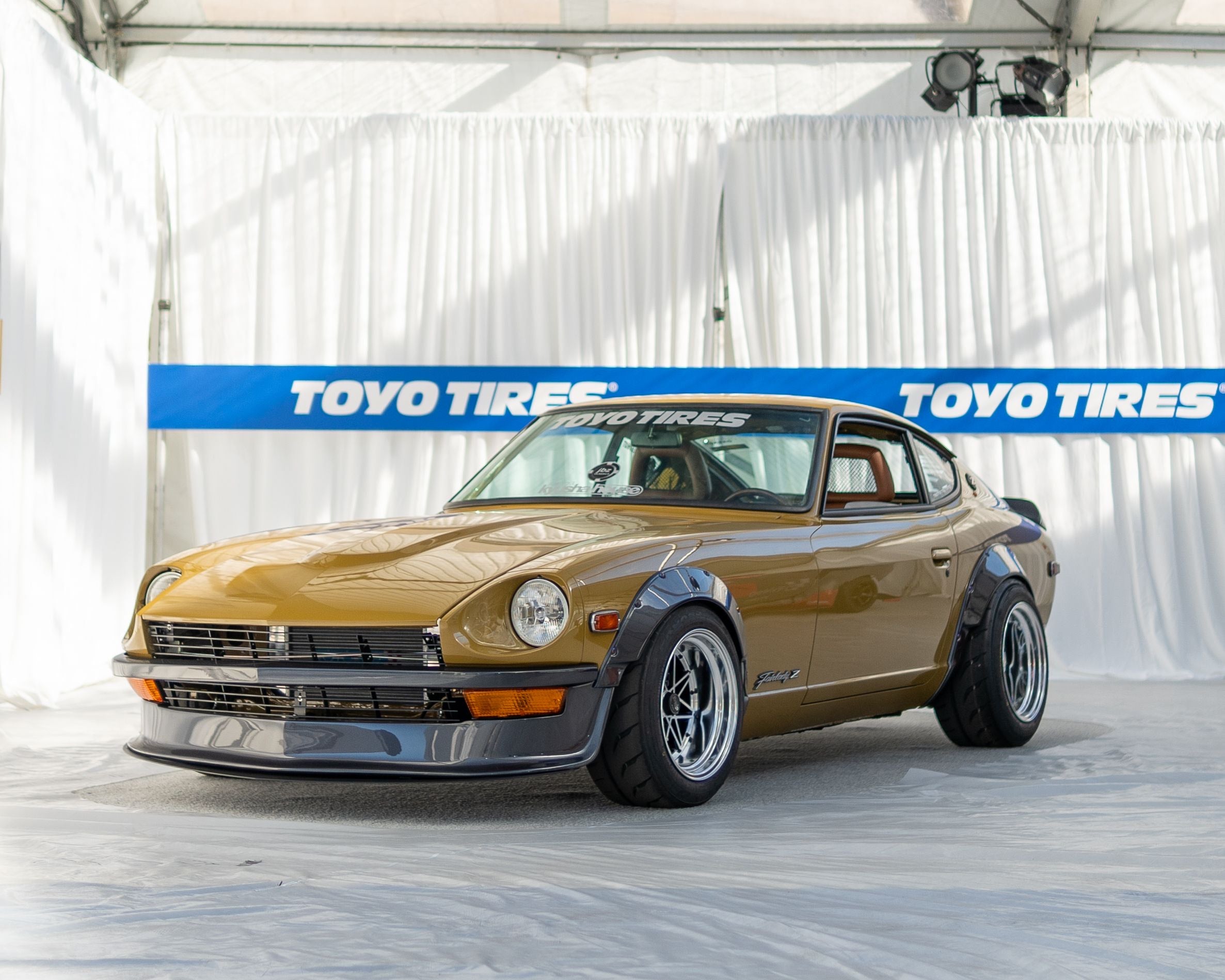
Most 240Z builds land in one of two places. The first is a flush or mild setup - the wheels sit right at the fender edge, but they don't stick past it. The second goes more aggressive, with wheels tucked or stretched to get that low, wide stance that the car is known for. These are great directions, and neither one is a wrong answer. What does change between them is what each one asks of your suspension, your budget and your time.

Some owners want a car that drives great and looks the part, all at the same time. Others are after something that'll spend most of its life on a trailer and only come off it long enough to get photographed at a show. Neither one is the wrong answer. But they do turn out to be two very different projects.
The direction that you settle on at this stage can affect everything that comes after it - your springs, your wheels and even whether your tires rub through turns. The sooner you're honest with yourself about what you actually want the car for, the less frustration you'll carry into the rest of the build. A flush fitment that still drives well is difficult to get right, and an aggressive setup that ignores how the car needs to work tends to create more problems than it solves.
Choose your goal before anything else, and most of the next decisions will start to answer themselves.
How Low Should the Car Sit
The stock 240Z sits quite a bit higher than most builders are going for. Nissan built it with plenty of ground clearance, which made total sense for the roads of the early 1970s - and all that extra height leaves plenty of room to work with.
Most builders drop the car by anywhere from 1.5 to 2.5 inches from stock height. That range gets you a more planted stance without the fenders landing in a bad position over the tires, and it leaves the car comfortable enough to drive on roads.
A car that scrapes on every driveway exit or speed bump gets old pretty fast, and at some point no amount of style makes up for it. Before settling on a drop height, have an honest look at how you actually use the car. Weekend cruises to a show and back will call for a very different setup than a day-to-day driver that also sees the occasional track day. How you answer that question ends up shaping your call more than almost anything else.

A build that does double duty (show days, weekend drives, the occasional road trip) usually lands best right around 1.5 inches of drop. It's a sensible number that holds up across most conditions. A more dedicated track car or a static display build has quite a bit more flexibility to push toward the upper end of that range.
Neither direction is a wrong call - it just depends on what the build is for. Day-to-day drivability matters, and an aggressive drop is hard to walk back once you've committed to it. A slightly conservative starting point gives you more flexibility to fine-tune the setup once the car is on the road. The factory ride height is the baseline, and a sense of where that sits makes the whole call easier to work through.
Coilovers or Lowering Springs for the 240Z
Once you have your target ride height locked in, the next step is figuring out how to actually get there.
Coilovers give you a pretty high level of control over your ride height. Businesses like Techno Toy Tuning and BC Racing each make kits that are designed specifically for the 240Z, and with either one, you can raise or lower the car to just about wherever you want it to sit. That sort of flexibility is hard to replicate with other suspension setups - and it matters a whole lot more once you've locked in on a very particular look.

Lowering springs are the easier and more budget-friendly option. You pull out the factory springs, drop in a shorter set, and the car sits at a fixed height. There's no adjustment and no way to change it after the fact - whatever drop the springs are rated for is right where your car lands.
That's also where quite a few 240Z owners second-guess themselves. Without any way to fine-tune the height after the fact, you're locked into whatever drop those springs give you. If it ends up too aggressive (or not quite enough), your only option is to order a different set and do the whole job over again, which is probably the worst part of fixed-rate springs.
Coilovers do cost a bit more up front, and there's no way around that. The investment in all that adjustability tends to pay off over time, though - for anyone who wants to get every little detail just right. It's worth asking yourself whether that trade-off is worth it - losing that level of control to go with a budget option just to save a few dollars.
How Wheel Size and Offset Affect Your Fitment
Wheels are probably the single biggest visual part of a 240Z - more than almost anything else, the right set can change what the car looks like. For the S30 chassis, a wheel somewhere in the 15x8 to 15x9.5 inch range is usually right where you want to be. That width gives the car a planted stance without going too far overboard.
Width alone doesn't tell you the full picture, though. Offset is what actually controls how far in or out the wheel sits within the arch, and it's a spec worth checking before you buy a set. With a negative offset, the mounting face moves toward the rear of the wheel - it's what pushes the wheel face outward. The more negative that number gets, the more the wheel ends up sticking out toward the fender lip.

A bad fitment job will legitimately ruin the look of your build, and there are two ways it can do that. Some owners have tires that poke way out past the fender, and others go too far in the opposite direction - wheels so tucked in that the whole stance ends up looking flat and hollow. Neither of them is where you want to land, and either way it will cost you money to fix.
A tape measure and a quick run through an offset calculator can save you from ending up with wheels that don't fit the way that you pictured them - and in my experience, that extra step is always worth the 5 minutes. Even with the offset dialed in just right, a wider wheel on a lowered car can still push the tire right up against the fender when the suspension compresses, or you crank the wheel to full lock. The next section covers all that in more detail.
Roll the Lip or Add a Flare
The fender wells on a 240Z are notoriously tight, and they don't leave a whole lot of room to play with. Go a bit wider on your wheel and tire setup (the rear especially) and you'll burn through that clearance faster.
The two main options for more wheel clearance are to roll the fender lip or to add a flare. A rolled lip bends the inner edge of the existing metal upward, which opens up more room without any change to the outer shape of the fender. A flare is a separate piece that bolts onto the outside and extends the fender outward. Either one will solve the problem - but they're very different in terms of cost, labor and how the car ends up looking.

Before anything else, temperature matters here. Cold metal is rigid and way less forgiving - it's far more likely to crack the paint or crease in the wrong place if you try to roll it. Get the metal warmed up first and work through it slowly.
The first question to answer before any bodywork decisions get made is how much tire rub you're willing to live with. A little rub under full lock or hard suspension compression is something that plenty of owners just accept and move on from. Non-stop rub on a flat road is a different story - that's going to eat through a tire way faster than you want. That answer should point you toward whether a roll job alone makes sense or whether the full flares are the better call.
Camber and Alignment After the Drop
Once the fenders have enough clearance, the alignment needs to be next on the list. A lowered 240Z pulls the wheels inward at the top, and the camber change puts uneven pressure across the tire's contact patch. Without an alignment correction, the inner edge of your tires will wear down quite a bit faster.
The upside is it's a well-understood problem, and there are some fixes for it. Camber plates mount at the top of the strut and let you adjust the angle from above - they're pretty easy to work with. Adjustable control arms do a similar job from below, and they're a great fit if you want to bring the geometry back closer to factory spec. These are options and either one will get you where you want to be.

A fair warning about how this usually plays out. Plenty of 240Z owners get the car sitting just where they want it, put miles on it and then start trying to work out why the inside edges of the tires are wearing down so fast. The drop looks right, the car feels normal, and the alignment shop is easy enough to drive right past - at least until the tires start making it obvious on their own.
A full four-wheel alignment after any suspension change is the step that makes everything else worthwhile. The camber adjustment hardware does most of the work. But a decent alignment tech with a lift and a spec sheet is what actually completes the job. Skip that last step and your performance and tire life will suffer - it's a rough trade-off after everything you just put into the drop. The alignment is the final part of the whole project.
Stance Mistakes That Hurt Your Build
The most frustrating builds usually have one trait in common - somebody skipped a step just to finish a little faster.
One of the biggest mistakes is to go too low without a plan for ride quality. A slammed car looks sharp in photos - nobody's going to argue with that. The question is whether the trade-off is worth it to you - it's something worth figuring out well ahead of settling on a number.
Wheel offset is another area that's easy to get wrong. Get it off in either direction, and your wheels could be pressed into the fenders or recessed way too far back inside the arch - and once you've already bought the wheels, neither one is a fun problem to sort out.

And camber is a functional part of the build. Leave it out, and you'll pay for it in how the car drives, how fast it wears through the tires and how well it holds up over time.
Tire fitment under unrolled fenders is another area where patience actually pays off. A tire forced into a gap that hasn't been rolled or flared right will almost always cause rubbing and damage - and neither one is a fun fix.
Work that has to be done twice gets expensive fast, and the costs pile up. Before you move forward, ask yourself whether this build needs to manage daily driving - because that answer should shape just about every choice that you make from here on out.
Build Your Dream Car
A 240Z that sits just right doesn't happen by accident. It's the result of a series of connected decisions - made in the right order, with genuine attention paid to each one along the way. Ride height, wheel fitment, fender clearance, camber - none of these exist in a vacuum. The builds that look effortless are usually the ones where the owner slowed down, measured and thought two steps ahead before a single dollar left their wallet.
The difference between a build that actually comes together and one that turns into a cycle of expensive repairs usually traces back to one factor - planning. Owners who walk away happy with their results are usually the ones who figured out what they wanted the car for before they ever bought a single part. Street cruiser, track car, show build or some combination of all three - the answer needs to come first, because every choice after it gets a little easier and usually quite a bit cheaper once it does.

That also makes it easier to choose the right parts the first time around. At Skillard, we design and build custom parts made just for Datsun models (the 240Z, 260Z and 280Z) so no matter where your project is headed, there's something in our catalog for your build. Bumpers, aluminum door cards, center consoles and spoilers, all built to the standard these cars deserve. The right parts matched to the right platform help if you want to land a particular look or feel.
Whenever you're ready to take the next step, check us out at Skillard.com to see what we have available for your car.